Guides
Permentan 6 of 2025: Plantation Company Obligations for Land Fire Prevention
A complete summary of Indonesia's Minister of Agriculture Regulation No. 6 of 2025: RKPPLP, fire task forces, core crews, CCTV surveillance towers, reservoirs, and mandatory equipment for plantation companies to prevent land fires.
Every dry season, land fires threaten plantations across Kalimantan again. Smoke, crop losses, and legal risks can bring plantation operations to a halt within days.
The government has responded with Minister of Agriculture Regulation No. 6 of 2025 (Permentan 6/2025), enacted on 19 March 2025. It updates the obligations of plantation businesses to clear land without burning and to control fires, including a requirement to use early detection technology.
This article summarizes what plantation companies and smallholders must comply with, including the minimum standards set by the regulation.
What Is Permentan 6 of 2025?
Permentan 6/2025 amends Regulation No. 05/Permentan/KB.410/1/2018 on Plantation Land Clearing and/or Cultivation Without Burning. The amendment adapts the rules to technological developments and makes plantation fire control more effective.
The regulation applies to two groups:
- Plantation Companies: Indonesian legal entities that manage plantations above a certain scale. Their obligations are detailed, from planning to equipment.
- Smallholders (Pekebun): Indonesian individuals who farm below a certain scale. Their obligation is simpler: report before clearing land.
8 Key Obligations of Plantation Companies
1. Hold an RKPPLP approved by the local agency (Article 4)
Before clearing or cultivating land, a company must have a Plantation Land Clearing and/or Cultivation Work Plan (RKPPLP) approved by the Head of the provincial or regency/city plantation agency. The application is submitted in writing with the following documents:
- company profile
- Plantation Subsector Business License
- annual plantation development work plan
- 1:50,000 scale digital map, in printed and electronic form
- a signed statement of commitment to clear land without burning
2. Build a fire control system (Article 14)
The company must have a fire control system covering three elements: organization, human resources, and control operations.
3. Form a Fire Control Task Force (Article 15)
The task force (Satgas) is established by company management. At minimum it consists of a head, a secretary, officers in charge (prevention, suppression, logistics), and firefighting crews.
4. Prepare core crews based on plantation size (Article 17)
The number of core crews is based on the land area stated in the Business License:
- 25 – less than 500 ha: 1 crew, 5 people
- 501 – 1,000 ha: 1 crew, 10 people
- 1,001 – 5,000 ha: 2 crews, 30 people
- 5,001 – 10,000 ha: 3 crews, 45 people
- 10,001 – 20,000 ha: 4 crews, 60 people
- More than 20,000 ha: a combination of the above
5. Implement early hotspot detection (Articles 21–22)
This is the most notable change in Permentan 6/2025. Companies must monitor hotspots using one or a combination of:
- fire lookout towers
- surveillance towers equipped with cameras/CCTV
- real-time remote sensing hotspot monitoring systems
Monitoring is run by the task force, using hotspot data from the Ministry of Forestry, BMKG (Meteorology, Climatology and Geophysics Agency), and/or BRIN (National Research and Innovation Agency).
6. Extinguish fires within the licensed area (Article 23)
If a fire breaks out in the licensed area, the company must extinguish it with its own crews. If the fire cannot be controlled, the task force coordinates with the Fire Brigade, community fire groups (KTPA), Manggala Agni, the local fire department, or other companies' task forces. Firefighting crews must also file a fire report.
7. Provide fire control facilities (Article 25)
Required facilities include firefighting equipment, data processing and communication tools, transportation, and supporting equipment. The minimum standard for one core crew of 5–10 people includes:
- Personal gear: helmet, mask, goggles, gloves, firefighting boots and suits for each member
- Crew gear: tent, first aid kit, workshop tools, lighting, drone or binoculars
- Hand tools: axe-hoe, fire beaters, rakes, shovels, 5 backpack pumps, chainsaw
- Water pumps: 1 main pump with hoses, 5 portable pumps, water tank, peat injection tool (for peatland)
- Data and communication: 2 GPS units, 5 handheld radios, megaphone
- Transportation: personnel vehicle, equipment vehicle, and patrol vehicle (car, boat, or speedboat)
8. Build reservoirs or water storage (Article 30)
Companies must build at least 1 reservoir or water storage unit for every 500 ha of plantation, with a total capacity of at least 800 m³.
Obligations of Individual Smallholders (Article 6A)
Permentan 6/2025 adds a new article specifically for smallholders. Before clearing or cultivating land, smallholders must submit a written report to the Village Head and the Head of the regency/city agency.
The report is accompanied by a copy of the ID card (KTP), a copy of the land title document, and/or a Plantation Registration Certificate (STD-B). After that:
- The Village Head provides assistance no later than 5 working days after receiving the report.
- The regency/city agency conducts monitoring and evaluation no later than 10 days after the assistance.
What Are the Risks of Non-Compliance?
Company readiness is evaluated by the Fire Control Brigade through document verification and field verification (Article 34). The evaluation results and recommendations become input for the plantation business assessment.
This means missing or broken equipment can directly affect a plantation's assessment. In addition, the Plantation Law prohibits clearing land by burning and imposes criminal penalties for it.
Standards for Fire Lookout Towers and CCTV Surveillance Towers
Appendix III of Permentan 6/2025 contains the technical specifications for towers. It is the main reference when planning an early detection system.
Fire lookout tower (manual):
- Quantity: oil palm plantations 1 unit per 250–600 ha, sugarcane plantations 1 unit per 1,000 ha
- Permanent frame made of wood or steel
- Platform at least 3 m above the tallest crop canopy
- Equipment: work map, binoculars, compass, communication device
- Staffed according to the BMKG Fire Danger Rating System (SPBK): Normal every 3 days, Alert 3 daily, Alert 2 and Alert 1 around the clock
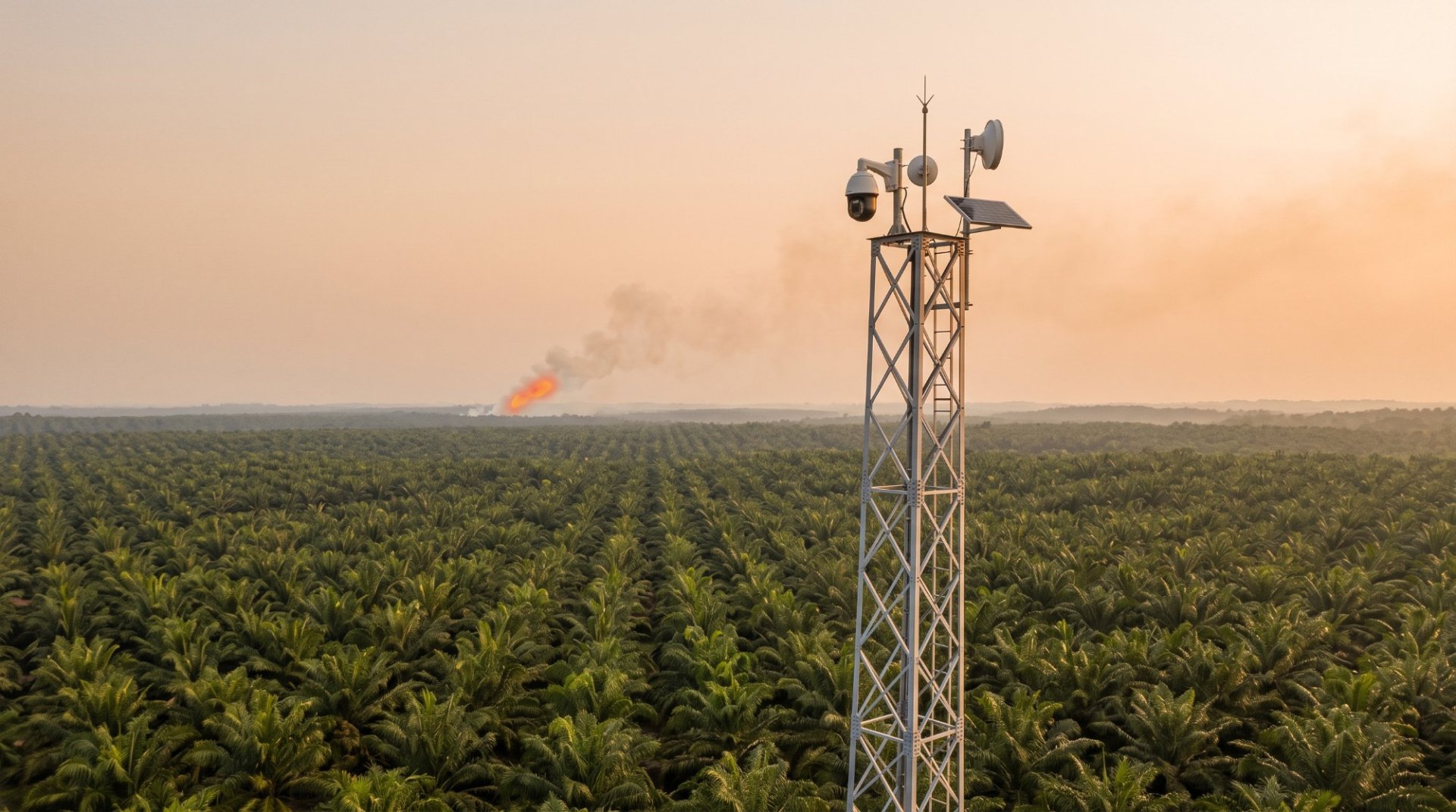
CCTV surveillance tower:
- Quantity based on camera coverage
- Steel frame, at least 3 m above the tallest crop canopy
- Camera/CCTV equipped with a heat detection sensor
- Must be fitted with lightning protection, internet connectivity, and power supply
- Operates daily in real time
Thermal CCTV surveillance towers have a clear advantage: monitoring runs continuously without depending on guard schedules, and hotspots can be seen from a control room. The key lies in three things named directly in the regulation: heat-sensing cameras, a stable internet connection at the plantation site, and reliable power and lightning protection.
Permentan 6/2025 Compliance Checklist
Use this list to check your plantation's readiness:
- RKPPLP approved by the Head of the agency
- 1:50,000 digital map available in printed and file form
- Fire control task force established by management decree
- Number of core crews matches the land area in the Business License
- Fire lookout towers and/or CCTV surveillance towers installed
- Hotspot monitoring system connected to BMKG or related agency data
- Firefighting equipment complete and working
- GPS, handheld radios, and communication tools ready
- Personnel, equipment, and patrol vehicles available
- At least 1 reservoir per 500 ha with a total capacity of 800 m³
- Preparedness report (Format-8) prepared and kept up to date
Frequently Asked Questions
When does Permentan 6 of 2025 take effect?
It takes effect on the date of promulgation. The regulation was enacted on 19 March 2025.
Is Permentan 05/2018 still in force?
Yes. Permentan 6/2025 only amends certain articles. The other provisions of Permentan 05/2018 remain in force and should be read together.
Are CCTV surveillance towers mandatory?
Early detection is mandatory. It can be done with fire lookout towers, CCTV surveillance towers, and/or real-time hotspot monitoring systems, or a combination of these.
How many reservoirs are required for a 2,000 ha plantation?
At least 1 unit per 500 ha, so a 2,000 ha plantation needs at least 4 reservoirs or water storage units.
Do smallholders also need a task force?
No. Smallholders only need to submit a written report to the Village Head and the regency/city agency before clearing land.
Prepare Your Plantation's Early Detection System with CV. Connect
Permentan 6/2025 requires plantation companies to move from manual monitoring to technology-based early detection. CV. Connect Computer Network has served government and corporate clients in Kalimantan since 2015 and is ready to help your plantation meet these standards:
- site survey and surveillance tower placement planning
- supply and installation of thermal CCTV with heat detection sensors
- internet connectivity for plantation areas, including long-range radio links
- power systems, backup power, and lightning protection
- real-time monitoring control rooms
Consult us about your plantation's needs:
- Phone: +62 511 327 3774
- WhatsApp: +62 821-1999-0999
- Address: Jl. Pahlawan No. 44 RT. 07, Banjarmasin, South Kalimantan, Indonesia
Source: Minister of Agriculture Regulation No. 6 of 2025, JDIH BPK. This article is for general information and does not constitute legal advice.
Need a solution for your organisation?
Talk to our team about your requirements — free and with no obligation.